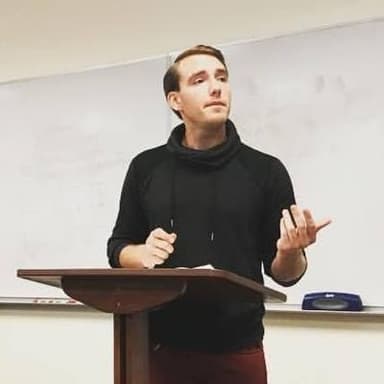
JOHN CONNOR
Founder & CEO
Building debate clubs, events, and championships — city by city
THE SOUTH SIDE
I grew up in various neighborhoods on Chicago's South Side—the kind of place where your options feel predetermined before you're old enough to question them. Neither of my parents have college degrees. Neither had made it to the middle class. The path forward seemed clear enough: maybe the military, maybe become a firefighter. Respectable goals. Safe goals.
At 15, I was captain of the football team at Thomas Kelly High School. I spent two-plus hours working out every day. I had the discipline part figured out. What I didn't have was anyone to talk to about the things that actually interested me.
I read philosophy books at night: Nietzsche, Plato, whatever I could find. It soothed my soul. But I had no one to discuss any of it with. No outlet for the questions bouncing around in my head. No framework for thinking through ideas systematically. Just a vague sense that there was more to the world than what I could see from where I stood.
My history teacher noticed something. I liked to argue with other students in class. I'd push back on claims, question assumptions, derail lessons with tangential debates. She probably found it exhausting. But instead of writing me off, she made a recommendation to Scott Dodsworth, the head debate coach.
Scott recruited me. I think the logic was that I needed a constructive outlet, somewhere to channel all that argumentative energy so I'd be less disruptive and more focused. A place where being contrarian was a feature, not a bug.
I had no idea what I was getting myself into.
THE FIRST TIME I SAW A VARSITY ROUND
It was bizarre. Alienating. Convoluted. Competitors spoke at speeds I didn't know were humanly possible, rattling off arguments about nuclear proliferation, economic theory, philosophical frameworks I'd never encountered. They referenced authors I'd never heard of, deployed terminology that felt like a foreign language, and did it all with a confidence that bordered on arrogance.
I remember sitting in the back of that room feeling a complicated mix of emotions. Confusion. What were they even talking about? Frustration. Why was this so inaccessible? But underneath all of that, something else: admiration. Even awe.
How did they get so precise in their thinking? How did they develop that level of confidence in their positions on genuinely complex issues? How could I learn to think like that?
It was ugly. The spreading, the jargon, the insular culture of it all. But it was also awesome in the original sense of the word—it inspired awe. I saw something in that room that I wanted. Not the trophies or the status. The clarity. The rigor. The ability to hold a complex position and defend it against serious challenge.
I decided to give debate a chance.
LEARNING THE HARD WAY
I'd done theatre before. I'd been the lead in a few musicals, so I wasn't worried about speaking in front of people. Stage fright wasn't my problem.
Debate was different. There's something uniquely exposing about having your actual thinking, not just your performance, subjected to direct adversarial scrutiny. Every round felt like an anxiety-filled rush. My stomach would knot up. My hands would shake. I'd second-guess every argument I'd prepared.
At my first tournament, I went 3-1. Three wins, one loss. I thought I'd performed reasonably well, all things considered. I had no idea what I was doing, but I'd held my own. When the awards were announced, my name wasn't called. I figured that was fair. I was brand new, still learning the basics.
A week later, I got a call. They'd miscalculated some scores. I had actually won 3rd place speaker in the novice division.
That small validation changed something in me. I was hooked.
But here's what I don't think people understand about competitive debate, especially from the outside: it doesn't get easier. Not for a long time. The better you get, the harder the competition. The higher the stakes, the more intense the pressure.
For over two years, I thought about quitting before every single tournament. Every one. Even as I started winning first place speaker awards. Even as I started making semifinals and finals consistently. The anxiety never went away. I'd lie awake the night before competitions, running through arguments in my head, convinced I'd forgotten something critical, certain I'd embarrass myself.
It wasn't until the middle of my third year that something shifted.
I learned to put my ego aside.
That sounds simple, but it was the hardest lesson debate taught me. When you stop trying to prove you're smart and start genuinely engaging with the ideas, when you become more interested in finding the truth than in winning the argument, everything changes. The anxiety fades. The beauty of the activity reveals itself.
Policy debate, at its best, is one of the most elegant intellectual exercises humans have devised. Two teams, deeply researched positions, rigorous clash, real-time adaptation. It's chess at the speed of conversation. It's philosophy as a competitive sport.
City-Wide Varsity Champion
That year, my senior year, I won the city-wide varsity championship. I was 18 years old. A kid from the South Side whose parents never went to college. A former jock who'd stumbled into this strange, convoluted activity because his history teacher thought he argued too much.
It was something I never would have dreamed of at 15.
WHAT CAME NEXT
I went to college on a full debate scholarship. I won a championship there too. Debate had taken me from a working-class neighborhood with limited horizons to a world of ideas, opportunities, and possibilities I hadn't known existed.
The trophies aren't the point. The skills are the point.
And those skills don't expire when you graduate. Not a day goes by, literally not a single day, that I don't actively use something I learned in debate.
BUILDING THINGS
After college, I became a builder. Products, companies, communities. Always at the intersection of emerging technology and human behavior. Always trying to create things that matter.
HelpWith.co
2013-2018A peer-to-peer marketplace for local services and skill-sharing. Built from nothing, grew to over 3,000 service providers. Designed an AI-powered recommendation engine from scratch, years before "AI-powered" became a marketing buzzword.
Business of AI
2018-PresentProduct strategy consulting for over 30 tech startups, from early-stage ventures to growth-stage companies. Notable clients include Karma Circle and Work+Shelter.
ModeMobile
2019-2020Led product as Technical Product Manager, managing 15 people to develop the Earning app and Earn Phone. Built AI-powered opportunity suggestions that significantly improved personalization and conversion rates.
Upland.me
2020-2021Product and Ops Manager. Designed the growth strategy that increased revenue 15x and scaled to 300,000+ monthly active users, establishing Upland as a top-ranked Web3 game. Led the launch of the "Spark" token, onboarding 100,000+ users.
Sparkblox
2021-2024Founded NFT 2.0 infrastructure company. Led $1M+ fundraising, built partnerships with Chainlink and Algorand, launched multiple six-figure Web3 art projects with 20+ artists.
THE THROUGH LINE
Here's what connects all of it: debate.
AS A FOUNDER
Debate gave me the confidence to believe that my ideas could change the world. Not naive confidence—earned confidence. The kind that comes from having your positions stress-tested thousands of times. You just have to keep showing up.
AS A STRATEGIST
Debate trained me to analyze complex systems quickly. To research unfamiliar domains and extract what matters. Every product strategy I've ever developed runs on the same cognitive infrastructure.
AS A COMMUNITY BUILDER
Debate taught me the nuances of grassroots engagement. How to convey complex ideas in ways that truly resonate. How to build cultures where rigorous thinking is valued and rewarded.
AS A HUMAN BEING
Debate taught me empathy. Not the soft, sentimental kind—the hard kind. The kind where you're required to argue positions you disagree with, to inhabit worldviews that aren't your own.
To that community: the debate community, the Chicago community, the communities of builders and founders trying to make things better. I am always indebted.
COMING FULL CIRCLE
I've spent the last decade watching public discourse collapse.
Social media platforms optimized for engagement, not understanding. Algorithmic feeds that serve you what makes you angry, not what makes you think. Cable news that treats every issue as a tribal loyalty test. Online spaces where nuance goes to die.
The basic human skill of arguing well has been lost. Constructing a position, defending it against challenge, being genuinely open to changing your mind. We've forgotten that disagreement can be productive. That being wrong is how you learn. That the person on the other side of an argument might have something valuable to teach you.
Where do adults go to actually debate ideas? Not to perform for an audience or dunk on opponents. To genuinely engage with difficult questions?
The answer, mostly, is nowhere.
SuperDebate is my attempt to rebuild that.
The first large-scale adult debate network since ancient times. Local clubs where you can show up and argue about ideas that matter. Live events where skilled debaters clash in front of engaged audiences. A community where the best arguments win—not the loudest voices, not the most inflammatory takes, not the algorithm's favorite outrage.
I'm building SuperDebate because I know what debate did for me. A 15-year-old jock from the South Side with no clear future, transformed into someone who could hold his own in any intellectual arena. Someone with the confidence to start companies, the skills to build products, the fortitude to keep going when everything falls apart.
I'm not building this because I think I'm right about everything.
I'm building it because I've been wrong about a lot—and the experience of having my mind changed by a good argument is one of the best things I know. Most platforms are designed to make you more certain. SuperDebate is designed to make you more curious.
I wouldn't be who I am if it weren't for debate. I want to make that possible for more people.
LET'S CONNECT
Interested in debate, building communities, or just want to chat? I'd love to hear from you.
john@superdebate.org